
How to Search Eaton County Court Records
Eaton County points the public to its Public Case Search page, which routes into Michigan's statewide MiCOURT system. The county does not run its own in-house case database. Instead, the gateway links a searcher to the circuit, district, or probate search, and the searcher picks the court before typing anything. That choice matters, because each court holds a different set of files.
The county's Public Case Search landing page is the starting point for most record lookups.
A lead-in link to the county gateway helps set expectations before a search begins.
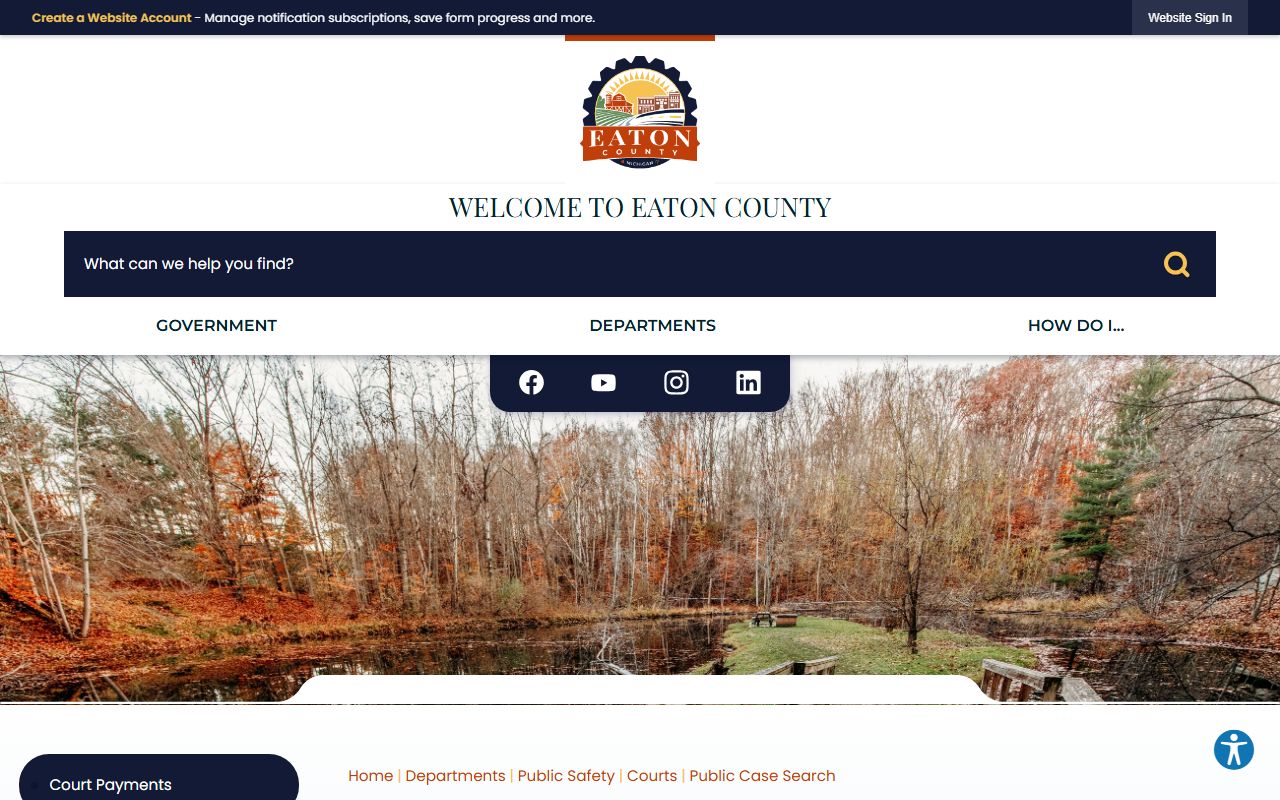
The screen above shows how the county sends users to the correct court search rather than a single merged result set. Before starting, have a name or a case number ready. A case number gives the cleanest match, while a last name and first name work when the number is unknown.
- Open the county Public Case Search page and choose the court you need: circuit, district, or probate.
- Accept the terms and move into the MiCOURT case-search application.
- Search by case number if you have it, or by last name and first name if you do not.
- Narrow the results with filters such as case type, judge, case status, or a date range.
- Open the matching result and review the parties, hearing dates, docket entries, and case status.
- Request a certified copy from the clerk if you need a document that holds up in court.
Marriage licenses, vital-record orders, and other non-court services sit on the county's Online Services hub rather than in the case search.
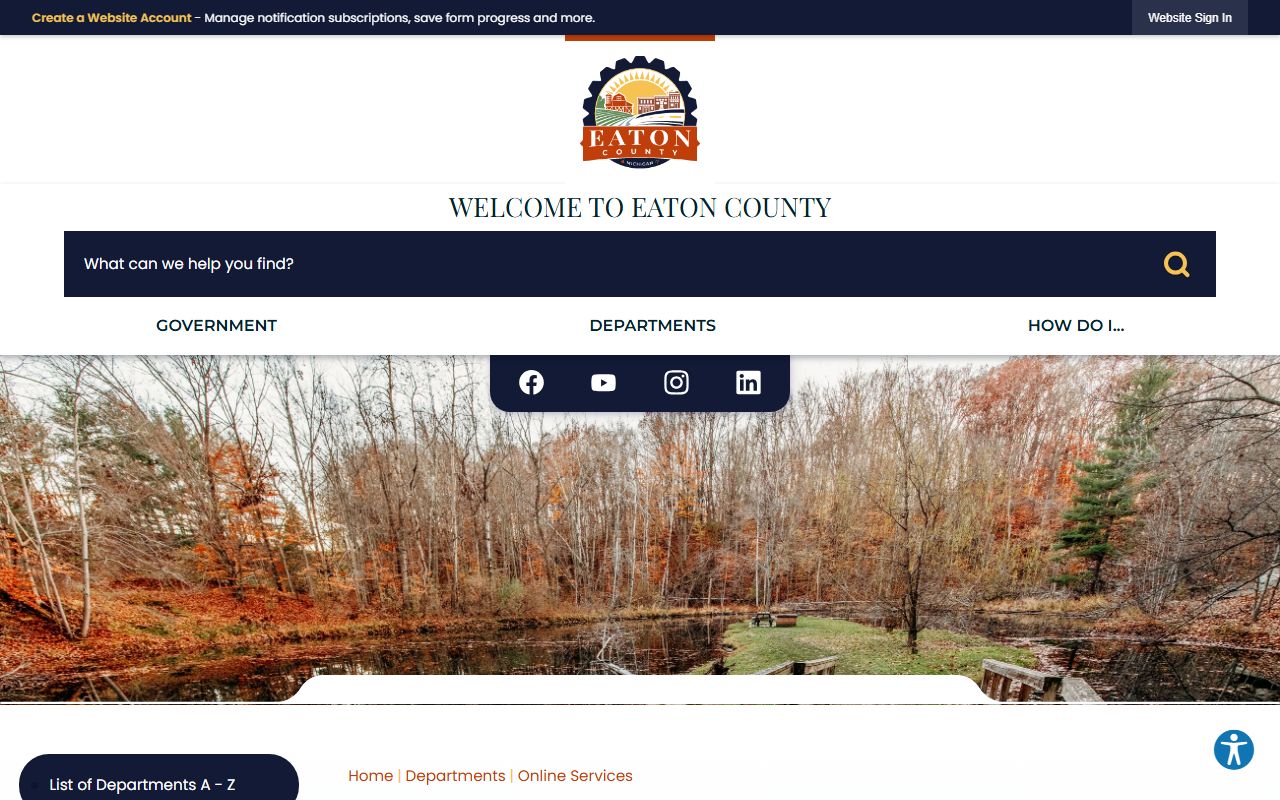
The online-services hub collects the county's web forms in one place, which keeps license and copy requests separate from live docket searches. Note: probate balances shown in the case search may not be accurate, so call the probate court to confirm any money total.
The Eaton County Judicial System
Michigan's trial courts start with the circuit court for general jurisdiction, the district court for limited jurisdiction, and the probate court for estates and related matters. Above them sit the Michigan Court of Appeals and the Michigan Supreme Court. Eaton County fits that structure directly with one circuit court, one district court, and one probate court. There is no justice-of-the-peace or municipal-court layer in this county.
The 56th Circuit Court is the county's main trial court for felonies, larger civil disputes, and family matters. Its judges are Janice K. Cunningham, the chief judge, and Kelly E. Morton.
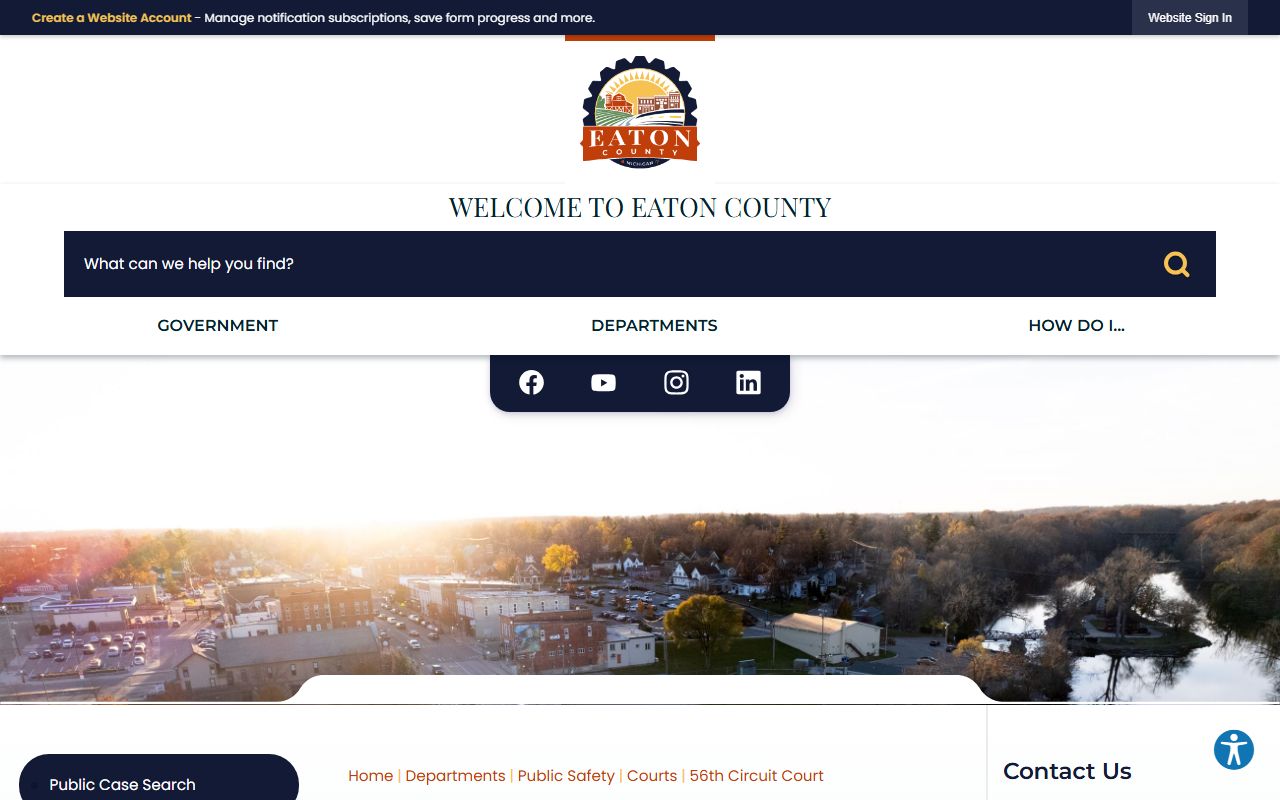
The circuit court page above lists the judges a docket entry may point to, which helps connect a case to a real courtroom. The 56A District Court handles misdemeanors, civil infractions, traffic cases, small claims, landlord-tenant disputes, lower-dollar civil suits, and felony preliminary exams. Its judges are Adrianne Van Langevelde and Reid Felsing. The Probate Court, led by Judge Amanda G. Pollard, keeps estate, guardianship, and conservatorship files.
Case flow: District Court and Circuit Court (trial level) › Michigan Court of Appeals › Michigan Supreme Court
| Court | Jurisdiction | Case Types |
|---|---|---|
| 56A District Court | Limited | Misdemeanors, traffic, civil infractions, small claims, landlord-tenant, felony preliminary exams |
| 56th Circuit Court | General | Felonies, larger civil cases, family and domestic relations |
| Probate Court | Specialized | Wills, estates, trusts, guardianships, conservatorships, name changes, emancipation |
| Michigan Court of Appeals | Appellate | Appeals from Eaton County trial courts |
| Michigan Supreme Court | Highest state court | Final discretionary review |
Michigan's judiciary publishes a plain overview of how these trial courts fit together on its trial-court structure page.
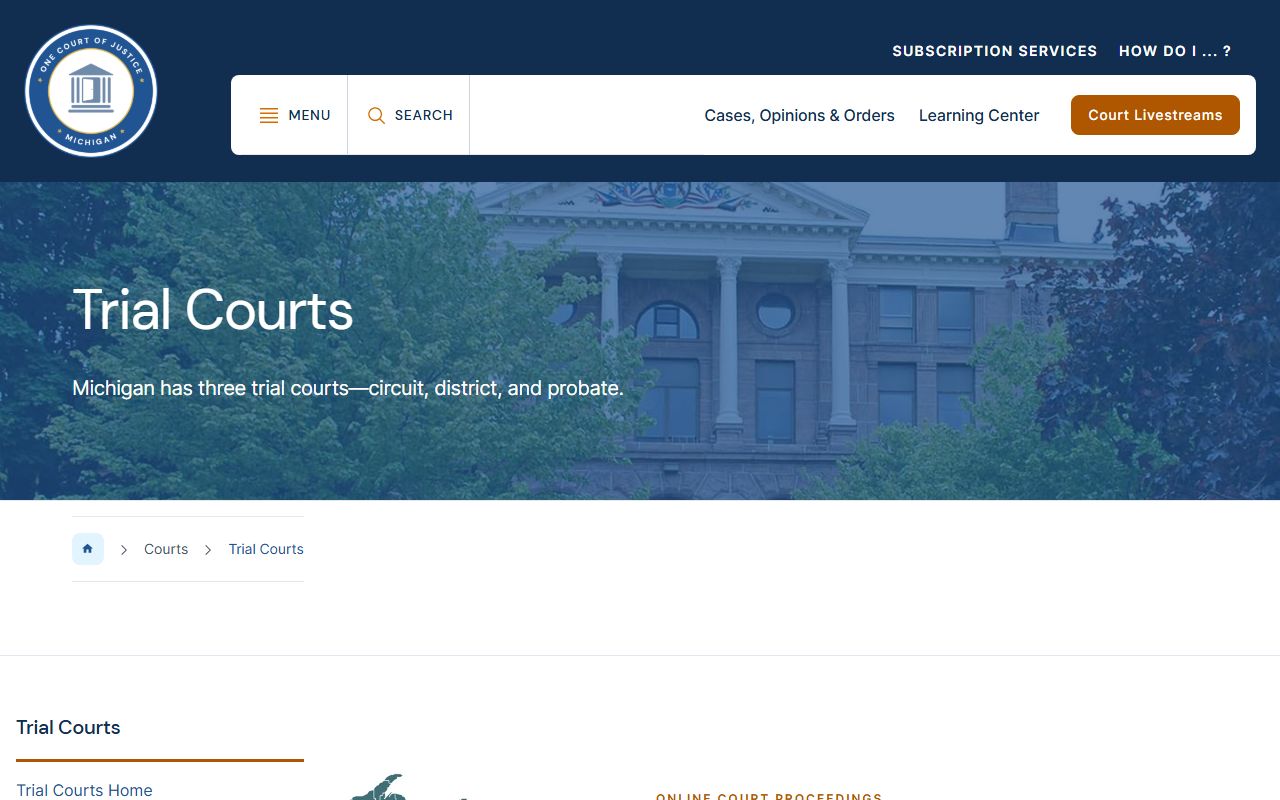
That state page confirms the same three-court split a searcher will see in the county gateway, so the court choice made at the start of a search lines up with how Michigan organizes its trial courts.
Types of Court Records Available in Eaton County
Eaton County's records are organized by court level and subject matter rather than in one merged county file. Circuit court files cover felonies, larger civil cases, and domestic-relations matters. District court files cover misdemeanors, traffic, civil infractions, small claims, and lower-dollar civil suits. Probate files cover estates, guardianships, and related matters. The public case search and the request forms follow those same divisions.
The 56A District Court is where most day-to-day public records begin, from tickets to landlord-tenant disputes.
The district court page above lists the divisions that produce the county's highest-volume records. The main categories a searcher will meet break down this way.
- Criminal records - misdemeanors sit in district court, felonies in circuit court after bindover.
- Civil records - contracts, property, personal injury, and district civil suits filed through MiFILE e-filing.
- Family and divorce records - divorce, custody, and support cases live in the circuit court.
- Probate records - wills, estates, guardianships, conservatorships, name changes, and emancipation.
- Traffic records - tickets, civil infractions, and dismissible or waivable violations in district court.
Juvenile records are the most restricted category and are not searchable like adult cases.
What Eaton County Court Records Show
An Eaton County court record is easiest to read as a mix of case-level details and a running docket. The county's search uses MiCOURT, and the visible fields a reader looks for are case number, court, judge, case type, filing date, case status, parties, and hearing dates. Probate adds some complexity because financial balances may not display cleanly in the public view.
Michigan's judiciary explains how trial courts keep and index these files on its records-management page.
That records-management overview shows why a public docket summary and a full case file are not always the same thing. The table below lists the fields a case result usually returns.
| Field | What It Shows |
|---|---|
| Case Number | The docket or tracking number that identifies the case. |
| Court and Division | Whether the case sits in circuit, district, or probate court. |
| Judge | The judge or magistrate assigned to the matter. |
| Parties | Plaintiffs, defendants, petitioners, and their attorneys. |
| Filing Date | When the case opened. |
| Case Status | Open, closed, deferred, disposed, or suppressed. |
| Disposition | How the case ended. |
| Financial Items | Fines, costs, restitution, or bond tied to the case. |
The county's district and probate request forms let a reader ask for a Register of Actions, the full case file, specific documents, or transcripts, which the online docket alone does not deliver.
MiCOURT Search Fields for Eaton County Cases
The county gateway keeps its front page simple, but the MiCOURT engine behind it supports far more filters. The MiCOURT case-search documentation lists the fields that power a party or case search. Knowing the full field set helps a searcher narrow a common name or a busy filing period.
The core fields are case number, first name, and last name, with a set of optional filters layered on top.
| Field Label | Type | Notes |
|---|---|---|
| Case Number | Text | Search by docket or case number. |
| First / Last Name | Text | Party name search. |
| Case Type Category | Dropdown | Adoption, appeals, civil, criminal, domestic, juvenile, non-traffic, probate, traffic. |
| Case Status | Dropdown | ADR, closed, deferred, disposed, mediation, open. |
| Public Status | Dropdown | Public or suppressed. |
| Judge | Dropdown | Filter by assigned judge. |
| DOB | Date | Date of birth filter. |
| File / Offense / Disposition Date | Date range | From and to date ranges. |
| DLN and VPN | Text | Driver license or vehicle plate number, with state. |
Results can be sorted by docket ID, tracking ID, newest, or oldest, and the public-facing search stays free.
Public Access Laws for Eaton County Court Records
Michigan builds public access to Eaton County court records on a mix of the Freedom of Information Act, court rules, and record-sealing statutes. County government records fall under FOIA, while court files follow the Michigan Court Rules. The county forms are the practical front door, but the statutes are the authority behind them.
Michigan Court Rule 1 sets out how court files and personal information are handled.
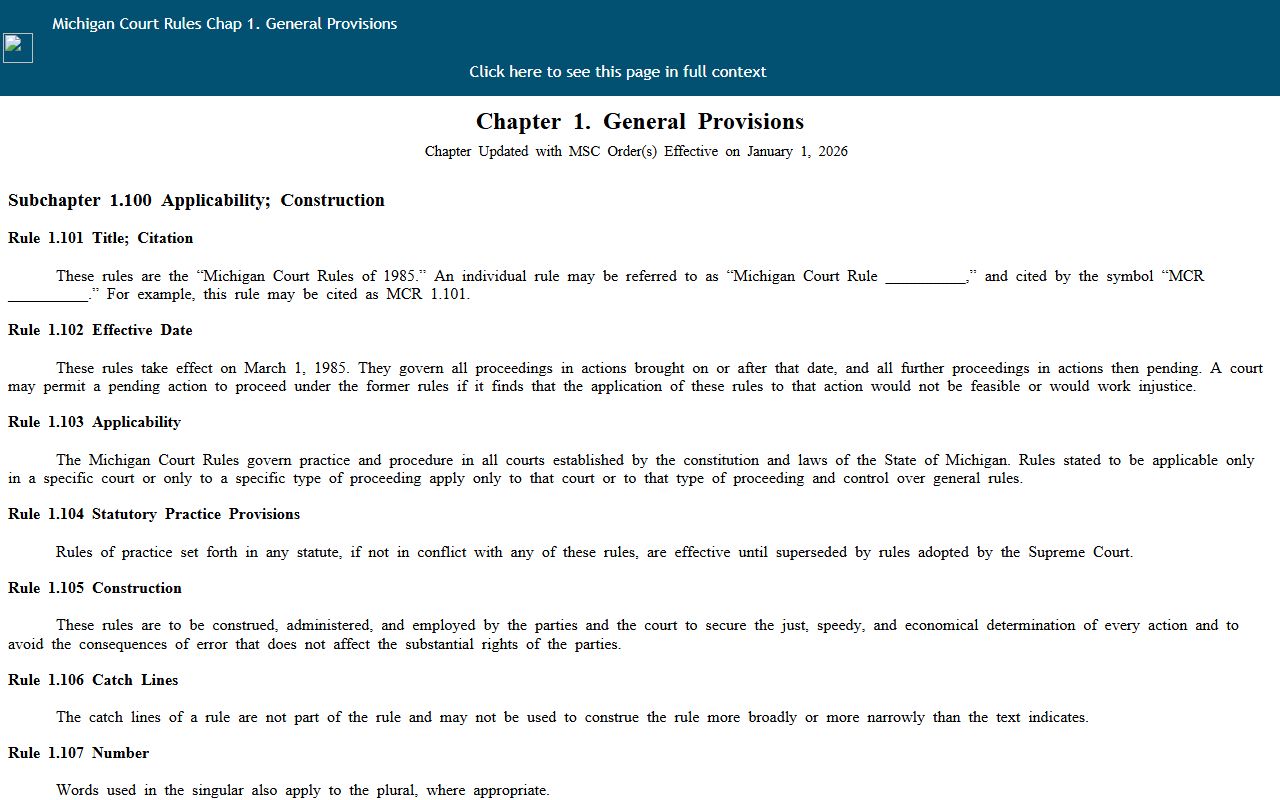
The court rules book above governs the record handling a reader relies on when a file is public or closed. The key authorities appear below in plain terms.
Key Statutes and Rules:
Michigan FOIA, MCL 15.231 - public records are presumed open unless an exemption applies.
FOIA exemptions, MCL 15.243 - lists records or portions that may be withheld.
Michigan Court Rule 1 - court records are generally public unless sealed or restricted by rule or order.
Set-aside statute, MCL 780.621 - certain convictions can be set aside by court order.
Juvenile access, MCL 712A.28 - juvenile records are restricted compared with adult files.
A reader usually starts with the county case search for live dockets, then uses the proper clerk office for copies or older files that never went online.
Records That Are Restricted or Confidential
Some Eaton County records are closed by law. Juvenile files, sealed or expunged criminal records, adoption files, and certain mental-health matters are not treated like ordinary adult cases. Public copies also redact sensitive identifiers such as Social Security numbers, financial account numbers, and the names of minors where a rule or statute requires it.
Michigan's judiciary landing page is a useful anchor for how the state frames open versus closed court files.
The state judiciary page above ties the local search back to the rules that decide what stays public. Expungement is the topic readers ask about most. In Michigan a set-aside does not erase the case; it removes a qualifying conviction from ordinary public view once a court grants it. A person still has to use the statutory route, which usually runs through the circuit court, and notify the prosecutor before any hearing.
Michigan's automatic clean-slate law also sets aside some records without an application under MCL 780.621g. Note: a sealed or expunged record is hidden from ordinary public search, not destroyed, and law-enforcement history can survive.
Eaton County Court Records Fees
Copy fees in Eaton County depend on which office holds the file. The Circuit Court Clerk handles court-record copies and charges a flat page rate for plain copies and a first-page rate for certified copies. The vital-records counter at the county clerk sets its own copy fees for birth, death, and marriage certificates.
The clerk's office cannot give legal advice, but it can confirm current totals before you pay.
| Item | Amount |
|---|---|
| Regular copy, per page | $2 |
| Certified copy, first page | $10 |
| Certified copy, each additional page | $1 |
| Certified vital record, first copy | $20 |
| Vital record, each additional copy of same record | $10 |
The circuit court clerk also accepts electronic submission by email for filings that do not open a new case and run under 100 pages, and a hardship fee waiver exists for vital-record copies.
How to Interpret Eaton County Court Records
Court files use shorthand that can mislead a first-time reader. The most important distinction is between a charge and a conviction. A charge is an accusation the prosecutor files, while a conviction is the outcome after a plea or a verdict. A record can list charges that were later reduced, dismissed, or dropped, so the disposition line is where the real result appears.
The comparison below sorts out the two terms readers confuse most.
| Point | Charge | Conviction |
|---|---|---|
| What it is | An accusation filed by the prosecutor | A finding of guilt by plea or verdict |
| When it appears | Early in the case | At disposition or sentencing |
| Can it change | Yes, it may be amended, reduced, or dropped | Final unless appealed or set aside |
| Public weight | Not proof of guilt | The court's binding outcome |
Case-status words carry their own meaning. Open means active, disposed means decided, and deferred means the court paused judgment under certain conditions. A dismissal without prejudice can be refiled, while a dismissal with prejudice cannot.
Eaton County Sheriff and Jail
The Eaton County Sheriff's Office, led by Sheriff Tom Reich, sits at 1025 Independence Blvd. in Charlotte, next to the courthouse complex. The main line is 517-543-3512, the records division is 517-543-5247, and the crime-tips line is 517-543-5433. The corrections division runs a 374-bed jail on the same campus.
Eaton County does not publish a public online jail roster. The county says a searcher must check each facility independently, and the Michigan Department of Corrections OTIS locator covers only sentenced state prisoners, not county-jail-only inmates. Full roster steps, visitation rules, and money-deposit options appear on the Eaton County inmate records page, and active-warrant questions are covered on the warrant records page. The sheriff directs warrant questions to 517-543-7500 ext. 4026 during business hours.
Marriage, Divorce, and Probate Records
Marriage licenses and certified vital-record copies run through the County Clerk and Register of Deeds office, while divorce files are circuit court records reached through the case search. That split trips up searchers who expect one counter to hold both. The Probate Court keeps a third set of files for estates, guardianships, conservatorships, name changes, and emancipation.
The probate court page lists the judge, hours, and full subject-matter menu in one place.
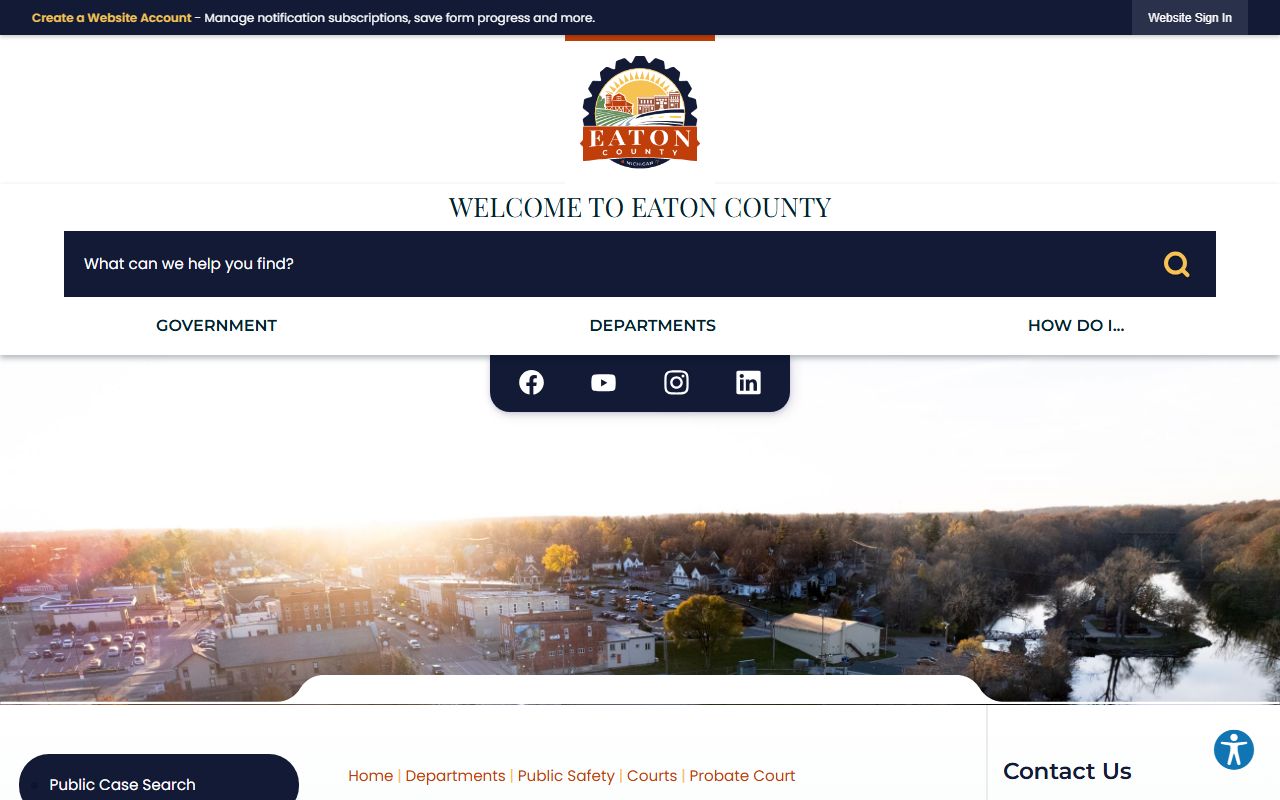
The probate page above shows how estate and guardianship matters stay separate from the marriage and vital-records counter. A reader who needs a marriage license or a certified copy starts with marriage and divorce records, while wills and estates start with probate records. A few probate terms come up often.
- Testator
- The person who makes a will.
- Executor
- The person named to carry out a will.
- Guardian
- A person appointed to care for someone who cannot care for themselves.
- Conservator
- A person appointed to manage another person's money or property.
- Intestate
- Dying without a valid will.
Accuracy and Record Limitations
Online court records lag behind the counter. A hearing held today may not post for a day or more, and probate financial balances in the case search can read incomplete. The safest move for money totals, a certified document, or a case that looks out of date is to call the office that holds the file. The circuit court clerk answers court-record questions, while the probate court answers estate and guardianship questions.
Note: Confirm case details, balances, and hearing dates with the originating court office before you rely on an online record for any legal or financial decision.
History of Eaton County Courts
Eaton County was organized in 1837 and named for John Eaton, who served as Secretary of War under President Andrew Jackson. Early county-seat activity began in Bellevue before Charlotte grew large enough to host county government. The first courthouse went up in 1845 for about $500, and a later courthouse followed before the current complex was dedicated on July 4, 1976.
The current 87,700-square-foot courthouse was designed in the New Formalism style by Robert Cain and Associates and built without added taxes. Its long records history shows in the first-record dates: probate from 1832, marriages from 1838, circuit judgments from 1847, and births and deaths from 1867. Those old series explain why some material still lives in books or archives rather than in the online portal.
Courthouse Location and Contact Information
All of the county's core courts cluster at one Charlotte address, so most court traffic is vertical inside the building rather than spread across town. The 56th Circuit Court sits on the second floor in Room 227, the 56A District Court is on the first floor, the County Clerk is in Room 145, and the Probate Court is in Room 111. The contact card below lists the main courthouse.
Eaton County Courthouse
1045 Independence Blvd.
Charlotte, MI 48813
Circuit Court Clerk: 517-543-4335
The Circuit Court Clerk keeps hours Monday through Friday, 8:00 a.m. to 5:00 p.m. The County Clerk and Register of Deeds office, at 517-543-2426, is open Monday through Thursday, 8:30 a.m. to 4:30 p.m., closed for lunch and closed Friday. The Probate Court answers at 517-543-4185.
Frequently Asked Questions
How do I search Eaton County court cases for free?
Open the county Public Case Search page, choose the circuit, district, or probate court, and accept the terms to enter MiCOURT. Search by case number or by last name and first name. The public search is free, and no account is required to look up a docket.
Which court holds my case?
Felonies, larger civil cases, and family matters sit in the 56th Circuit Court. Misdemeanors, traffic, small claims, and lower-dollar civil suits sit in the 56A District Court. Wills, estates, and guardianships sit in the Probate Court. Picking the right court is part of the search itself.
Does Eaton County post a public jail roster online?
No. The county says a searcher must check each facility directly, and the state OTIS locator covers only sentenced state prisoners. For custody questions, contact the sheriff's records division at 517-543-5247, or see the inmate records page for the full fallback chain.
How much does a certified court copy cost?
The Circuit Court Clerk charges $2 per page for a regular copy and $10 for the first certified page plus $1 for each additional page. Certified vital records at the county clerk cost $20 for the first copy and $10 for each additional copy of the same record.
Where are Eaton County divorce records?
Divorce files are court records held by the circuit court, not the vital-records counter. Reach them through the public case search or the circuit court clerk. Marriage licenses and certified marriage copies, by contrast, run through the County Clerk and Register of Deeds office.
How do I check for a warrant in Eaton County?
The county does not publish a public warrant list. Call the sheriff's warrant line at 517-543-7500 ext. 4026 during business hours. A failure-to-pay traffic warrant may be recalled by payment, while a failure-to-appear warrant usually requires an in-person court appearance.