
What the Eaton County Probate Court Handles
The Eaton County Probate Court is a single-court venue on the first floor of the courthouse in Charlotte. It hears wills and deceased estates, trusts, guardianships, and conservatorships. The same court also takes name changes, emancipation petitions, requests to open a safe-deposit box under court process, and the involuntary treatment of people with a mental illness. That mix means a probate file can be about money and property, about a person's care, or about a change of legal status. Each of those case types leaves its own record.
Probate is separate from the county's other trial courts. The 56th Circuit Court handles felonies, large civil suits, and divorce, while the 56A District Court handles traffic, misdemeanors, and small claims. Estates and guardianship matters do not sit in either of those. They live in the Probate Court, which keeps its own docket and its own case files. A reader looking for an estate or a guardianship needs to start with probate, not the general court counter.
The county department directory is a quick way to confirm where probate sits and how to reach it. The Eaton County probate court directory lists the office among the county's court departments.
That directory entry points to the same courthouse address shared by the circuit and district courts, so a single trip to Charlotte reaches all three. Probate has been a county function here for a long time, with the first probate records dating to 1832, which is why older estate files may sit in archived books rather than in a live database.
Probate Terms Defined
Probate filings carry words that rarely come up in daily life. A short guide to the most common terms makes a docket or an order easier to read. These are the roles and labels a searcher will meet most often in an Eaton County estate or guardianship case.
- Testator
- The person who made the will. The court reviews that will after the testator dies.
- Executor
- The person named in a will to carry out its terms. In Michigan this role is often called the personal representative.
- Administrator
- The person the court appoints to settle an estate when there is no will or no one named to serve.
- Intestate
- Dying without a valid will, so state law decides who inherits the estate.
- Guardianship
- A court order that gives one person authority to make care and personal decisions for someone who cannot.
- Conservatorship
- A court order to manage another person's money and property when they are not able to.
- Conservator
- The person the court names to handle that money and property under the conservatorship.
How to Search Eaton County Probate Records
Eaton County does not run its own probate database. Instead, the county's Public Case Search page routes users into Michigan's statewide MiCOURT case search system. A searcher picks the probate court first, accepts the terms, and then looks up a case by number or by party name. The search is free and open to the public. Because probate is one court among several in the gateway, choosing the right court is part of the search itself.
The online view is best for confirming that a case exists and for reading the docket. It is not a reliable accounting statement. The county warns that probate balances shown in the case search may not be accurate, so any question about money owed, fees, or estate totals should go to the court by phone rather than to the screen.
- Open the county Public Case Search page and select the probate court option.
- Read and accept the MiCOURT terms to enter the statewide search tool.
- Enter a case number if you have it, or search by the last and first name of a party.
- Open the matching result and review the parties, filing date, hearings, and docket entries.
- For any balance or fee total, call the probate court directly instead of relying on the displayed figure.
Note: The public case search shows a docket summary, so documents such as a will or an order still come through the court's copy request process.
Eaton County Probate Court Contact and Hours
The Probate Court sits in Room 111 on the first floor of the county courthouse complex in Charlotte. Judge Amanda G. Pollard presides. The office is the right contact for hearing dates, copy requests, and any balance question the online search cannot answer. The court page lists the subject matter it covers and the current office schedule.
Eaton County Probate Court
Room 111, Eaton County Courthouse
1045 Independence Blvd.
Charlotte, MI 48813
517-543-4185
Mon to Fri, 8:30 a.m. to 12:00 p.m. and 1:00 p.m. to 4:30 p.m.
The court has posted staff-development closures for June 26, July 24, and August 28, 2026. On those dates the office is closed for routine business, but emergency and in-custody matters are still handled. Anyone planning an in-person visit or a same-day copy pickup should keep those dates in mind and call ahead if the trip falls near one of them.
Requesting Eaton County Probate Records
When the online docket is not enough, the court's copy process delivers the underlying paper. The probate court record request form lets a person ask for a Register of Actions, the full case file, a specific order, or a transcript. The form collects the requester's name and contact details, then asks for the case number, the party name, and the type of copy needed. That structure keeps a plain docket lookup separate from a formal copy order.
The Eaton County probate court record request form is submitted through the county's online form center.
The form offers three ways to receive the record: by email, by first-class mail, or by pickup at the office. Email is the fastest route for a short document, while a full case file or a certified copy may be better collected in person. A requester who is unsure which delivery choice fits should note the copy type on the form and let the office confirm the total before the record is prepared.
Fees for Eaton County Probate Records
Copy charges for court records in Eaton County follow the rates published by the circuit court clerk, and those rates are the practical reference point for a probate copy as well. A regular copy runs by the page, and a certified copy carries a higher first-page charge plus a small fee for each page after that. Certified copies are the ones accepted for legal and financial use, so a plain copy will not stand in for a certified will or order.
| Item | Amount |
|---|---|
| Regular copy (per page) | $2.00 |
| Certified copy, first page | $10.00 |
| Certified copy, each additional page | $1.00 |
These figures come from the Eaton County Circuit Court Clerk copy schedule. Because probate can add its own charges for certain filings and services, the safer step is to confirm the exact total with the probate office before paying, especially for a large case file or a multi-page transcript.
Note: The county advises that probate balances in the online case search may be inaccurate, so verify any fee or balance amount with the court before you rely on it.
What Eaton County Probate Records Show
A probate file tracks a case from its opening petition to its closing order. In an estate matter, the record can include the will, the petition to admit it, the letters that name a personal representative, the inventory of assets, periodic accountings, and the orders that distribute property. A guardianship or conservatorship file carries the petition, the reports on the protected person, and the orders that grant or change authority. The docket ties these events together in date order.
Court records are governed by statewide rules rather than by a single county policy. The Michigan Court Rules set how trial court files are kept, what stays public, and how personal information is handled. Readers can review the framework in the Michigan Court Rules chapter on trial court administration.
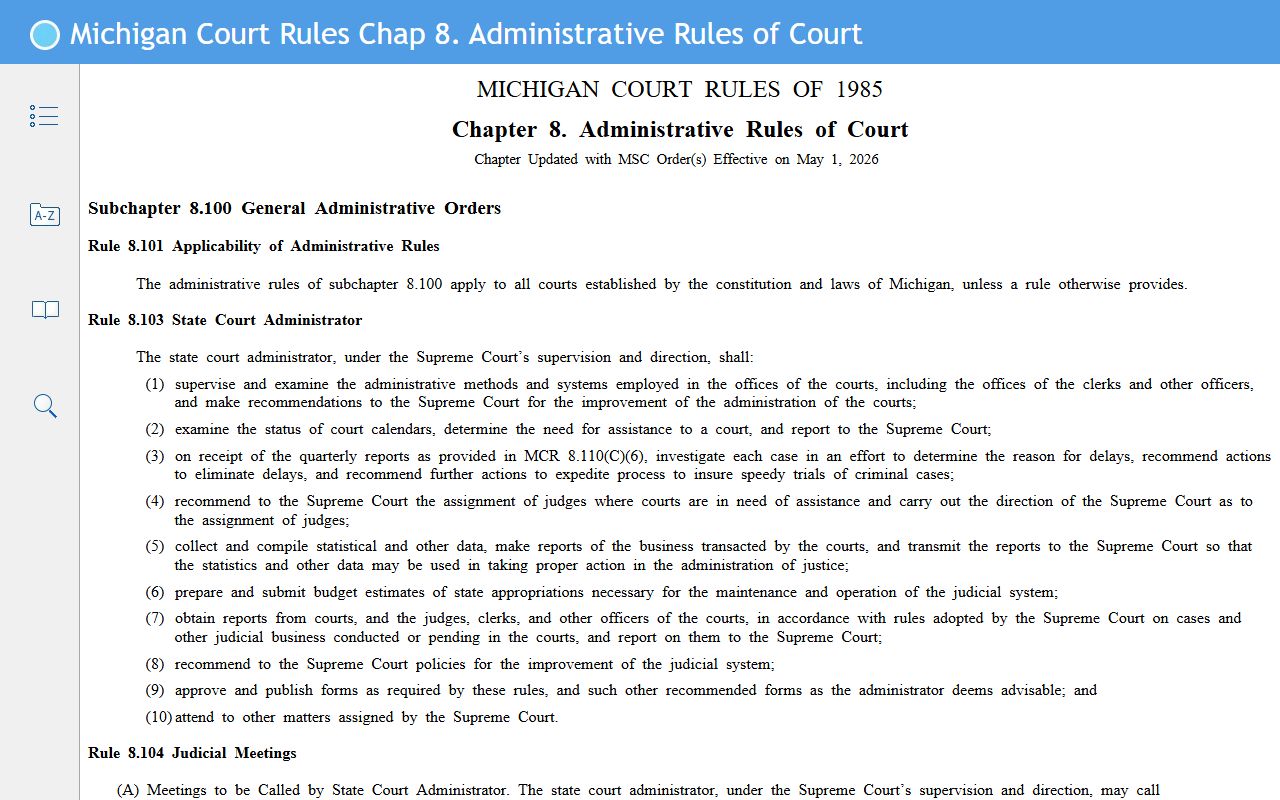
Those rules explain why a public docket may show event names and dates while the underlying documents come only through a copy request. A record copy is not always the same as the full file. The online search often shows the summary, and the clerk's copy process delivers the will, the order, or the transcript behind it. For marriage licenses and certified vital-record copies, which are a different set of documents, the county routes people to the Eaton County Clerk of Court rather than to probate.
Restricted Eaton County Probate Records
Not every probate matter is fully open. Records tied to the involuntary treatment of a person with a mental illness carry added privacy controls, and parts of those files are closed to the general public. Guardianship files that involve a minor and adoption-related records are limited by law as well. A public copy may also redact sensitive identifiers, such as a Social Security number or a financial account number, even when the case itself is open.
Juvenile matters draw the tightest limits. Michigan statute restricts access to juvenile records far more than to adult files, which is why a name that appears in an adult estate search may return nothing in a youth case. The Michigan juvenile record access statute, MCL 712A.28, sets out how those records are shielded.
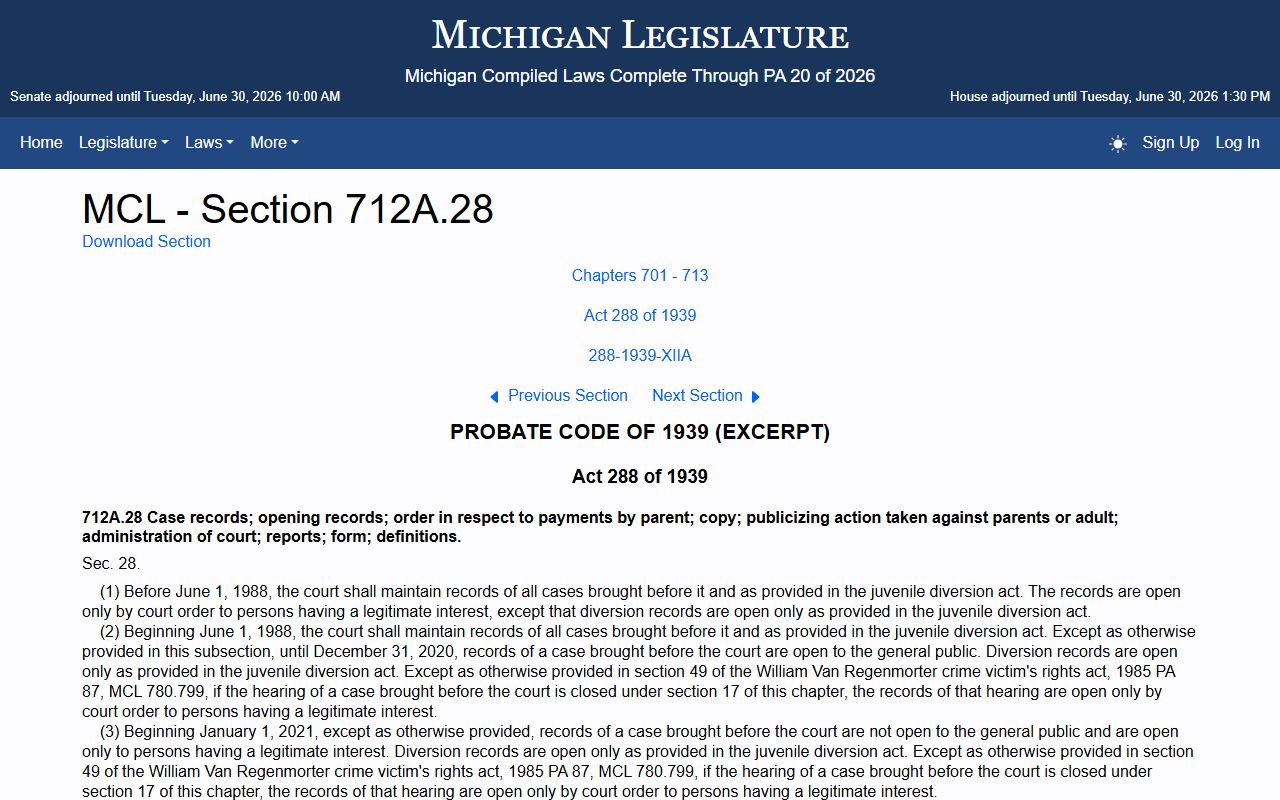
One more distinction matters for anyone who expects a records request to work like a county FOIA request. Court records and confidential court files are not subject to the Michigan Freedom of Information Act in the same way county administrative records are. Probate files are reached through the court's own case search and copy request process, not through a FOIA letter to the county. Knowing that early keeps a request on the right track and avoids a wait at the wrong office.