
How to Search Eaton County Traffic Court Records
Eaton County traffic cases are filed in the 56A District Court, so a traffic search starts the same way any court search does in the county. The county routes the public to its Public Case Search gateway, which passes into the statewide MiCOURT case-search system. There is no separate in-house ticket database. A user picks the court, accepts the terms, and then searches the live docket for open, closed, disposed, and deferred cases.
Before starting, it helps to have the citation number from the ticket, or the driver's full name. A case number, a date of birth, or a plate number can narrow a common name. The search itself is free, runs on the state system, and returns the docket rather than a paper copy of the file.
The county traffic division page is the best first stop for hours, payment links, and contact detail. A quick look at the Eaton County District Court traffic page confirms that traffic sits in the district court on the first floor of the courthouse in Charlotte.
That page and the county Public Case Search gateway together give a driver both the record search and the practical office detail needed to act on a ticket. To run a traffic citation lookup, follow these steps.
- Open the county Public Case Search gateway and choose the district court.
- Accept the terms and continue into the MiCOURT case search tool.
- Enter the citation or case number, or search by last name and first name.
- Narrow the results with filters such as case type, date range, or case status.
- Open the matching case to review the charge, court date, and disposition.
- From there, pay the fine, request a hearing, or ask the clerk for a certified copy.
Which Court Handles Traffic Cases in Eaton County
Every traffic ticket issued in Eaton County is handled by the 56A District Court traffic division. Michigan does not use justice-of-the-peace or separate municipal traffic courts the way some states do, so there is no web of local venues to sort through. The traffic office sits on the first floor of the Eaton County Courthouse at 1045 Independence Blvd. in Charlotte. Payments by mail go to 56A District Court Traffic Fines at that same address.
Walk-in arraignment is offered on set days and times, and those windows are narrow, so it pays to plan the trip. The county traffic FAQ lists the current walk-in schedule.
| Day | Walk-In Arraignment Hours |
|---|---|
| Monday | 1:00 p.m. to 3:00 p.m. |
| Wednesday | 8:30 a.m. to 10:30 a.m. |
| Friday | 8:30 a.m. to 10:30 a.m. |
The county keeps arraignment hours, warrant notes, and payment rules on one page for quick reference. The Eaton County traffic FAQ is where those day-and-time details are published.
Because one court holds every county ticket, a driver never has to guess the venue. The only real question is whether the matter is a civil infraction handled by the traffic division or a criminal charge routed elsewhere in the district court.
Types of Traffic Cases on Record in Eaton County
Most traffic tickets are civil infractions, not crimes. A civil infraction is a violation that carries a fine and possible license points but no jail time and no criminal record. The district court also handles misdemeanor traffic matters and the paperwork tied to commercial drivers. The record you find in a search depends on which type of case the citation opened.
- Moving violations - speeding, failure to stop, improper lane use, and similar civil infractions that carry points.
- Equipment and paperwork tickets - defective equipment, no proof of insurance, no registration, or no operator's license on the person.
- Misdemeanor traffic - offenses that require a personal appearance before a magistrate rather than a simple fine.
- Commercial vehicle violations - infractions tied to a commercial driver's license, which carry stricter federal reporting rules.
- Serious criminal driving offenses - drunk or drugged driving, which routes to the criminal side of the district or circuit court.
The county keeps civil infraction handling separate from criminal traffic for a reason. A civil infraction gives the driver a short window to admit, deny, or explain, while a criminal charge follows the arraignment and plea path that a misdemeanor or felony would take.
What Eaton County Traffic Court Records Show
A traffic case record is a court file, so it reads much like any other district court docket. It ties the citation to a driver, a charge, a court event, and an outcome. The MiCOURT system links traffic cases to charge dates, disposition dates, and driver or vehicle identifiers, so a single record can show both the case and the follow-up steps tied to it.
| Field | What It Shows |
|---|---|
| Citation Number | The ticket number that opened the case and the key used for a lookup. |
| Case Number | The district court docket number assigned once the citation is filed. |
| Charge and Statute | The violation charged and the Michigan Compiled Laws section behind it. |
| Parties | The driver named on the ticket and the issuing agency. |
| Court Date | Any scheduled arraignment, formal hearing, or informal hearing. |
| Case Status | Open, closed, deferred, or disposed as the case moves. |
| Disposition | How the case ended, such as admitted, dismissed, or found responsible. |
| Fine and Costs | The amount owed, plus any added costs after a default judgment. |
What the docket shows and what the clerk can copy are not always the same thing. The online view is a summary of events, while a district court record request can pull the full register of actions, the case file, or a certified document. Points and license consequences are tracked on the state driving record rather than the court docket.
Searching by Citation Number or by Name
There are two reliable ways into a traffic case. A citation or case number lands on the exact file with no guesswork, which is the fastest path when the ticket is in hand. A name search is the fallback when the number is lost, though a common name can return several matches that a date of birth or plate number helps sort. Either way, the court has to be chosen first, since results are court-specific.
The response fields below come from the county traffic process itself, since a driver often searches in order to respond. The lookup fields and the response options live in the same flow.
| Field | Type | Required | Notes / Format |
|---|---|---|---|
| Name | Text | Optional | Search by the party name on the ticket. |
| Case Number | Text | Optional | Search by citation or case number. |
| Court Selection | Link choice | Required | Choose the district court traffic division first. |
| Admit Responsibility | Response | Required in response flow | Use when accepting the citation. |
| Deny Responsibility | Response | Required in response flow | Use when contesting the citation. |
| Admit with Explanation | Response | Required in response flow | Use when requesting an explanation hearing. |
| Hearing Type | Selection | Optional | Formal judge hearing or informal magistrate hearing. |
| Extension Request | Written request | Required if used | Email or fax only, never by phone. |
Note: A citation number lands on one exact case, while a name search may return several people, so add a date of birth to narrow the list.
Paying or Contesting an Eaton County Traffic Ticket
A civil infraction gives a short window to respond, and missing it has real cost. The county civil infraction rules say a driver generally decides within 3 to 14 days and may admit responsibility, deny responsibility, or admit responsibility with an explanation. If no response comes in, the court can enter a default judgment and add costs on top of the original fine.
The county spells out the response choices and the deadlines on one page. The Eaton County traffic civil infraction page is where those options and the response window are described.
Denying or explaining a ticket sets up a hearing. A formal hearing is heard by a judge, and an informal hearing is heard by a magistrate. A driver who wants to handle the matter in person can use walk-in arraignment on Monday afternoon or Wednesday and Friday morning. Paying is the simpler path when the driver does not intend to contest, and the county accepts payment through several channels.
The county traffic payment page lists each accepted method and the phone code used for pay-by-phone. The Eaton County traffic payments page is the source for the phone number and the online option.
The steps below cover both paying and contesting a ticket, plus how to ask for more time.
- Read the citation for the response deadline, generally 3 to 14 days.
- To accept the ticket, pay by mail with a check or money order, by phone through GovPayNow and AllPaid at 1-888-604-7888 using location code PLC 6701, in person, or online through AllPaid.
- To contest, deny responsibility and request a formal hearing before a judge or an informal hearing before a magistrate.
- To explain the circumstances, admit responsibility with explanation and ask for an explanation hearing.
- To use a walk-in, come to the first-floor traffic office Monday from 1:00 p.m. to 3:00 p.m. or Wednesday and Friday from 8:30 a.m. to 10:30 a.m.
- To request more time to pay, send a written request by email to districtcourt@eatoncounty.org or by fax to 517-543-1469, since extensions are not granted by phone.
Note: A warrant for failure to pay can be recalled once the balance is paid, but a warrant for failure to appear requires a personal court appearance to resolve.
Public Access Laws for Eaton County Traffic Records
Traffic case files are public records under Michigan law. The state treats government records as open unless a specific exemption or court rule closes them, and court dockets are covered by the court records rules. That framework is why a driver, an attorney, or a member of the public can run a traffic citation lookup without showing a reason. Sensitive identifiers may be redacted, but the case itself is generally open.
Key statutes and rules:
Michigan FOIA, MCL 15.231 - public records are presumed open unless an exemption applies.
FOIA exemptions, MCL 15.243 - lists the records or portions that may be withheld.
Michigan Court Rules, Chapter 8 - court records are generally public unless sealed or restricted by order.
The online docket is the live front door, and a district court record request is the copy channel for anything the search does not display. For broader searches across every case type, the county's general Eaton County court records resources explain the same MiCOURT gateway used for traffic.
Court Traffic Record vs Michigan Driver Record
The most useful thing to understand about a ticket is that it lives in two different files. The Eaton County court keeps the case record, which shows the citation, the hearing, the disposition, and the fine. The Michigan Secretary of State keeps the driver record, which shows license status, convictions, points, suspensions, and revocations. Paying a fine settles the court case, but the conviction and any points still post to the separate state file.
The Secretary of State publishes the driving record and explains how to order it. The Michigan driving record page shows that the report is requested through MiLogin and lists what the record contains.
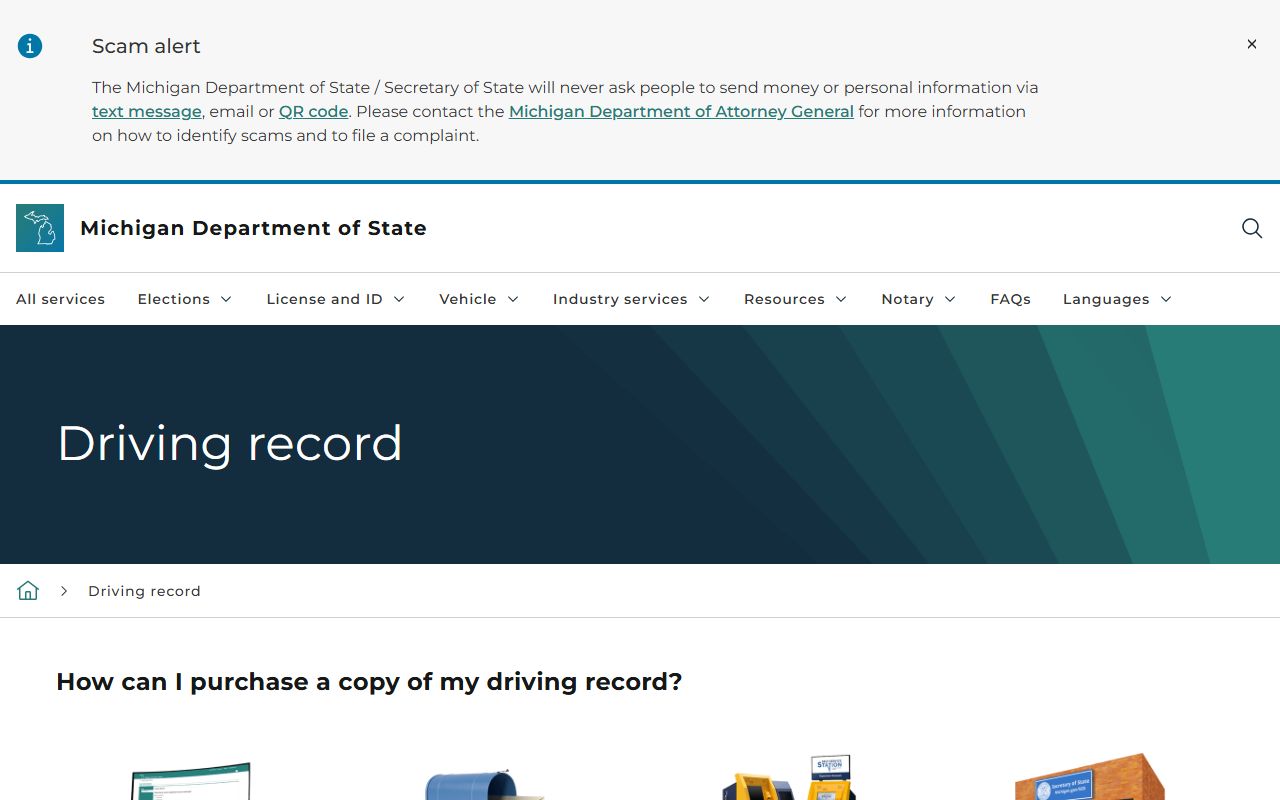
The comparison below lays out how the two records differ, from source to how errors get corrected.
| Comparison Point | Court Traffic Record | State Driver Record |
|---|---|---|
| Record source | 56A District Court, Eaton County | Michigan Secretary of State |
| What is in it | Citation, case, hearing, disposition, fine and costs | License status, convictions, points, suspensions, revocations |
| Where to access | County Public Case Search into MiCOURT, or a district court record request | Driving record ordered through MiLogin at the Secretary of State |
| How to correct errors | Contact the district court clerk or raise it at a hearing | Contact the Secretary of State to dispute the driver-history entry |
CDL and Commercial Driver Records
Commercial drivers face stricter rules than other motorists, and a traffic case can carry heavier consequences for a commercial driver's license. A CDL holder cannot use the driver-improvement course option that other drivers rely on, so a conviction is more likely to land on the record and stay there. Federal reporting rules also mean certain violations follow the license across states.
The state explains what the driving and vehicle record contains, including the credential details that matter for commercial drivers. The Michigan driver and vehicle records FAQ covers how those records are requested and released.
Because of those limits, a commercial driver has more reason to review both the court file and the state driver record before deciding how to respond to a ticket. What looks like a routine infraction can affect a livelihood.
DUI and DWI Cases in Eaton County
Drunk and drugged driving is not a civil infraction. Operating while intoxicated is a criminal charge, so it does not follow the pay-or-contest ticket path and does not sit in the traffic division's civil infraction flow. These cases move through arraignment, plea, and possible trial, and a conviction carries penalties well beyond a fine.
A driver looking for the full case file, the charges, and the sentence should look at the criminal side rather than the traffic docket. The Eaton County criminal court records resources cover how those cases are filed, heard, and disposed.
Driver Improvement Course for Eaton County Drivers
Michigan lets some drivers take a driver-improvement course to keep a civil infraction off the driving record. The county follows the state rule that the course is available for a civil infraction carrying less than 5 points, and it is not available to CDL holders. Completing the course can help a qualifying driver avoid the points that would otherwise post to the state record.
The county keeps the eligibility rules on its own page so drivers can check before signing up. The Eaton County driver improvement course page lays out the point limit and the CDL exclusion.
The course is only one option, and it does not fit every ticket. A driver with a heavier violation or a commercial license has to weigh a hearing or a straight payment instead.
Dismissible and Waivable Eaton County Traffic Tickets
Some tickets can be dismissed or waived when the driver fixes the problem and shows proof. These are usually paperwork and equipment violations rather than moving violations. Eaton County identifies several of them by statute, so a driver can check whether a ticket qualifies before paying it outright.
The county lists the waivable violations and the proof each one needs on a dedicated page. The Eaton County dismissible or waivable traffic page names the qualifying statutes.
The most common waivable tickets are tied to a few specific sections of the Michigan Vehicle Code.
- Defective equipment - MCL 257.683, resolved by fixing the equipment.
- No proof of insurance - MCL 257.328, resolved by showing valid coverage.
- No proof of registration - MCL 257.223, resolved by producing the registration.
- No operator's license on person - MCL 257.311, resolved by showing a valid license.
Fees for Eaton County Traffic Records
A traffic case search is free, but a paper or certified copy of the file has a fee. Copies come through the court records counter and the district court record request process, and the amounts follow the county's standard court copy schedule. Fine amounts, by contrast, are set by the specific violation and are not a fixed schedule, and a default judgment adds costs to whatever the ticket started at.
| Item | Amount |
|---|---|
| Plain copy, per page | $2.00 |
| Certified copy, first page | $10.00 |
| Certified copy, each additional page | $1.00 |
| Traffic fine and costs | Varies by violation |
To pull a certified traffic record, a driver files a district court record request and picks delivery by email, first-class mail, or pickup. The state driving record is ordered separately through the Secretary of State and is not part of the court's copy fees.
Note: Copy fees apply to the court file only, so a driver who needs the official conviction and point history must order the driving record from the Secretary of State.