
Criminal Court Records in Eaton County
A criminal court record is the case file a court builds once a prosecutor files a charge. It is not the same as an arrest report. The arrest is one early event, but the court record tracks the whole case as it moves from the first appearance to the last order. The file collects the charging document, the docket of events, each motion and hearing, the plea or verdict, and the final judgment. In Eaton County these files are held by the court clerk who serves the court that hears the case, and copies are requested through that clerk.
Two trial courts hear criminal matters in the county. The 56A District Court on the first floor of the Charlotte courthouse handles misdemeanors, civil infractions, and the early felony steps, including the preliminary examination. The 56th Circuit Court, on the second floor in Room 227, is the general-jurisdiction court that hears felony cases once they are bound over. The Eaton County Prosecuting Attorney decides what to charge and files the case that opens the record. The district criminal division explains which lower-level offenses require a personal appearance before a magistrate.
The county points readers to the district criminal division for the misdemeanor and felony-bindover workflow at the district level. The 56A District Court Criminal page describes filing options and the appearances tied to lower-level charges.
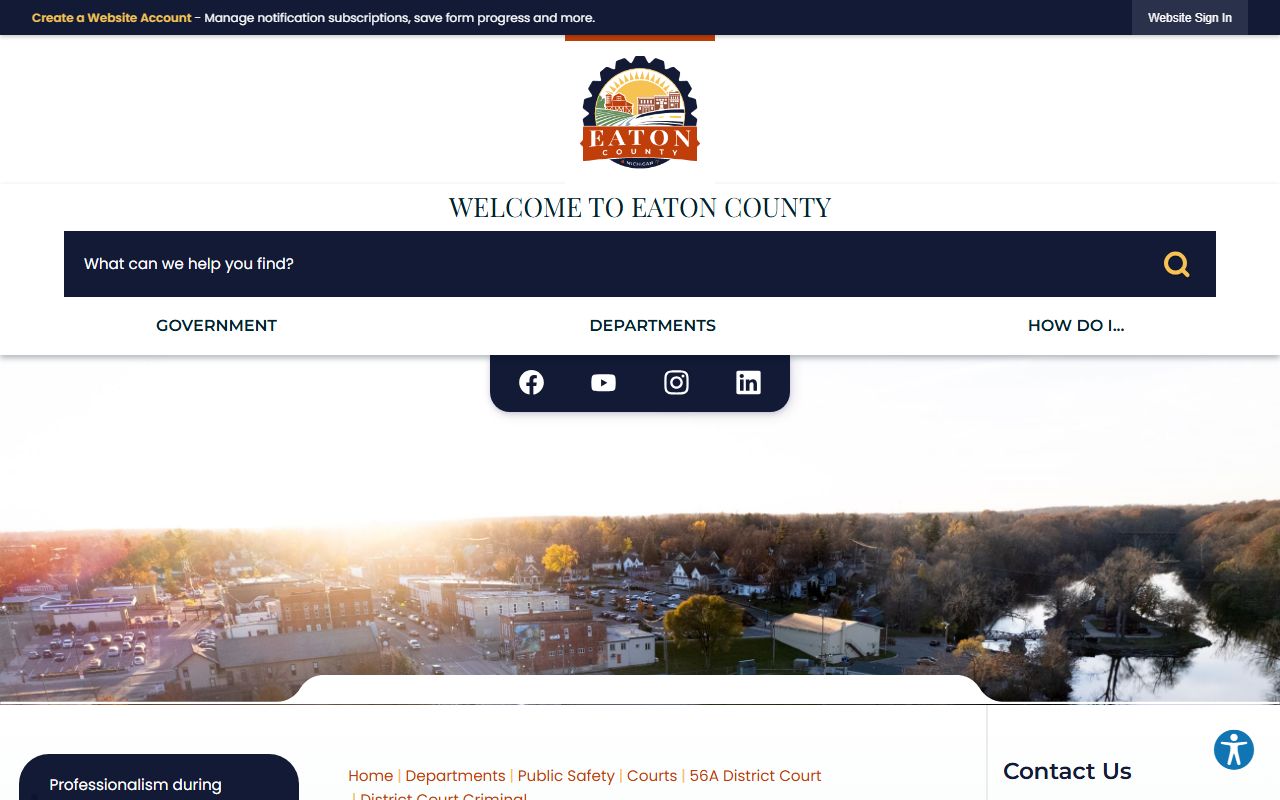
That page is the starting point for the district-level side of a criminal case file, where misdemeanor cases live and where felonies begin before they move up to circuit court. For a wider view of every case type the county keeps, the Eaton County court records overview maps how criminal, civil, traffic, and probate files fit together.
How to Search Eaton County Criminal Court Records
The county does not run its own case database. Instead, the county Public Case Search page routes users into Michigan's statewide MiCOURT system, where a searcher picks the court, accepts the terms, and then searches by name or case number. Criminal misdemeanors sit in district court, and felonies sit in circuit court, so choosing the right court is part of the search itself. The public search is free.
- Open the county Public Case Search gateway and pick the court you need, circuit or district.
- Accept the terms and enter MiCOURT, then search by defendant last name and first name, or by case number if you have it.
- Narrow the results using court-specific filters such as case type category, judge, and file, offense, or disposition date range.
- Open the matching case to read the docket, the parties, the hearing dates, and the disposition.
- Request a certified copy from the circuit court clerk if you need a document for legal use.
The MiCOURT developer notes show a deeper set of filters than the public page advertises, including case type category values for criminal and non-traffic cases, case status, date-of-birth, and driver-license fields. If a file is not online, the next step is a written record request to the clerk of the court that holds it, not a guess at another portal.
Stages of an Eaton County Criminal Case
A criminal case moves through fixed stages, and each stage leaves an entry in the court record. Reading the docket in order shows where the case stands and how far it has traveled. A misdemeanor may run its whole course in district court, while a felony passes through a preliminary examination in district court and then a bindover to circuit court for trial-level proceedings.
Case flow: Charges Filed › Arraignment › Pretrial / Motions › Plea or Trial › Disposition › Sentencing
| Stage | What Happens |
|---|---|
| Charges Filed | The prosecutor files a complaint that names the defendant and lists each charge, which opens the case file. |
| Arraignment | The defendant appears, hears the charges, and enters a first plea, and the court sets bond and release terms. |
| Pretrial / Motions | Lawyers exchange information, file motions, and for felonies a preliminary exam tests whether the case moves up. |
| Plea or Trial | The defendant pleads, or a judge or jury weighs the proof and returns a verdict. |
| Disposition | The record shows how the case ended: a plea, a verdict, a dismissal, or a diversion outcome. |
| Sentencing | After a conviction the judge imposes the sentence, and the terms are entered in the judgment. |
Note: A felony begins in the 56A District Court for its preliminary steps and moves to the 56th Circuit Court only after a bindover finds probable cause.
What an Eaton County Criminal Court Record Shows
The case file is built from metadata, docket entries, and the documents behind them. Through MiCOURT a reader sees case-level fields and the running event log, while the clerk's copy process can deliver the underlying orders and transcripts. A public search often shows a docket summary, but the full documents may need a formal request. The fields below appear across most criminal case files in the county.
| Field | What It Shows |
|---|---|
| Case Number | The docket or tracking number that identifies the case and its filing year. |
| Court and Judge | Whether the case sits in the district or circuit court and the judge or magistrate assigned. |
| Defendant | The person charged, listed with the case role. |
| Charges | Each count as filed, with the offense description and level, such as a misdemeanor or felony. |
| Plea | The defendant's response to each charge, such as guilty, not guilty, or no contest. |
| Hearing Dates | Scheduled events like arraignment, exam, pretrial, trial, and sentencing. |
| Disposition | How the case or each count ended, entered with the disposition date. |
| Sentence | The penalty imposed after a conviction, including jail, probation, fines, costs, or restitution. |
The search system can also filter by offense date and disposition date, which means a criminal record is tied to specific charge dates and outcomes rather than a flat list of names. Financial lines such as fines, costs, and restitution may show on the docket, but the safest source for an exact balance is the clerk of the court that holds the case.
Charges vs. Convictions
Being charged is not the same as being convicted, and a criminal court record can show both. A file may list a charge that was later dropped, reduced, dismissed, or that ended in an acquittal at trial. A charge is only an accusation, and it stands until the case reaches its disposition. A conviction is a finding of guilt, either by a plea or by a verdict, and only a conviction carries a sentence.
| Charge | Conviction | |
|---|---|---|
| Stage | Accusation at filing | Verdict or plea of guilt |
| Burden of Proof | Probable cause | Beyond a reasonable doubt |
| Can Change | Amended, reduced, or dropped | Final unless appealed or set aside |
| Public Record | Yes | Yes |
Because a charge and a conviction read very differently in a record, it is worth tracing each count to its disposition before drawing a conclusion. For a closer look at how charges are filed, amended, and dropped, the Eaton County arrest records and court charges page follows the charge side of the case.
Reading Dispositions and Sentences
The disposition is the line that tells you how a case ended. Common entries include guilty, not guilty, dismissed, and no contest, which is a plea that accepts the penalty without admitting fault. A deferred outcome means the court held the case open under conditions, and if the person meets them the charge may not become a conviction. Each disposition carries a date, and a case with several counts can show a different disposition for each one.
A sentence appears only after a conviction. In the record it may combine jail or a term in custody, probation, fines, court costs, and restitution paid to a victim. Probation is supervised release in the community, and a bond entry reflects the security set for release or appearance during the case. Reading these lines together shows both the outcome and what the court ordered the defendant to do.
Public Access to Eaton County Criminal Court Records
Michigan treats court records as open unless a rule, a statute, or a court order closes them. The public-access framework blends the state Freedom of Information Act, the court rules on record handling, and the statutes that allow a record to be set aside. County government records fall under FOIA, while court case files are governed mainly by the Michigan Court Rules. Together they let the public read most criminal dockets and request copies of the documents behind them.
Key Statutes and Rules:
Michigan FOIA, MCL 15.231 - public records are presumed open to the public unless a specific exemption applies.
FOIA exemptions, MCL 15.243 - lists the records or portions of records a public body may withhold.
Michigan Court Rule 1, MCR 1.109 - governs court files and limits on personal identifying information in the record.
When a file is not viewable online, the district and probate courts offer record-request forms that let a reader ask for a Register of Actions, the case file, specific documents, or a transcript, with delivery by email, mail, or pickup. The circuit court clerk handles copies of felony case files and can certify a document for court use.
Sealed vs. Expunged Records
People often use sealed and expunged to mean the same thing, but they describe different results. A sealed record is hidden from ordinary public view while it still exists in the system. An expunged, or set-aside, record is treated as though the conviction was removed from ordinary public access. In Michigan a set-aside does not mean the case never happened, and it does not erase every law-enforcement trace. It means the conviction leaves ordinary public search in the way the statute allows.
| Sealed | Expunged / Set Aside | |
|---|---|---|
| Visibility | Hidden from public search | Removed from ordinary public view |
| Law Enforcement | Limited access remains | Very limited access remains |
| How It Happens | By court order in a case | By court order or automatically under statute |
The core set-aside statute lets a person ask a court to set aside a qualifying conviction. The Michigan set-aside statute, MCL 780.621, describes which convictions can be set aside and the request process a person must follow.
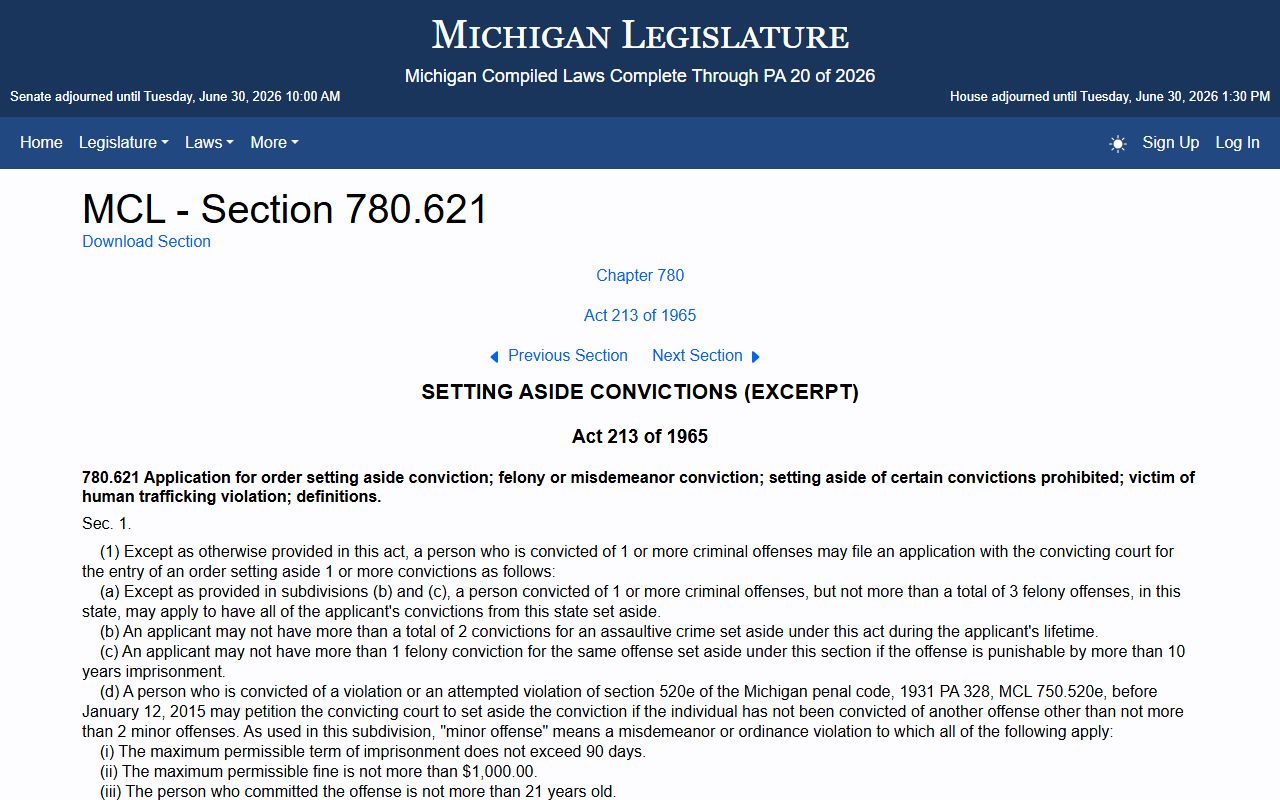
That statute is the traditional route where a person petitions the court, and the county case search does not replace it. Michigan later added an automatic path so some records clear without an application. The automatic set-aside statute, MCL 780.621c, explains which qualifying records are set aside by operation of law.
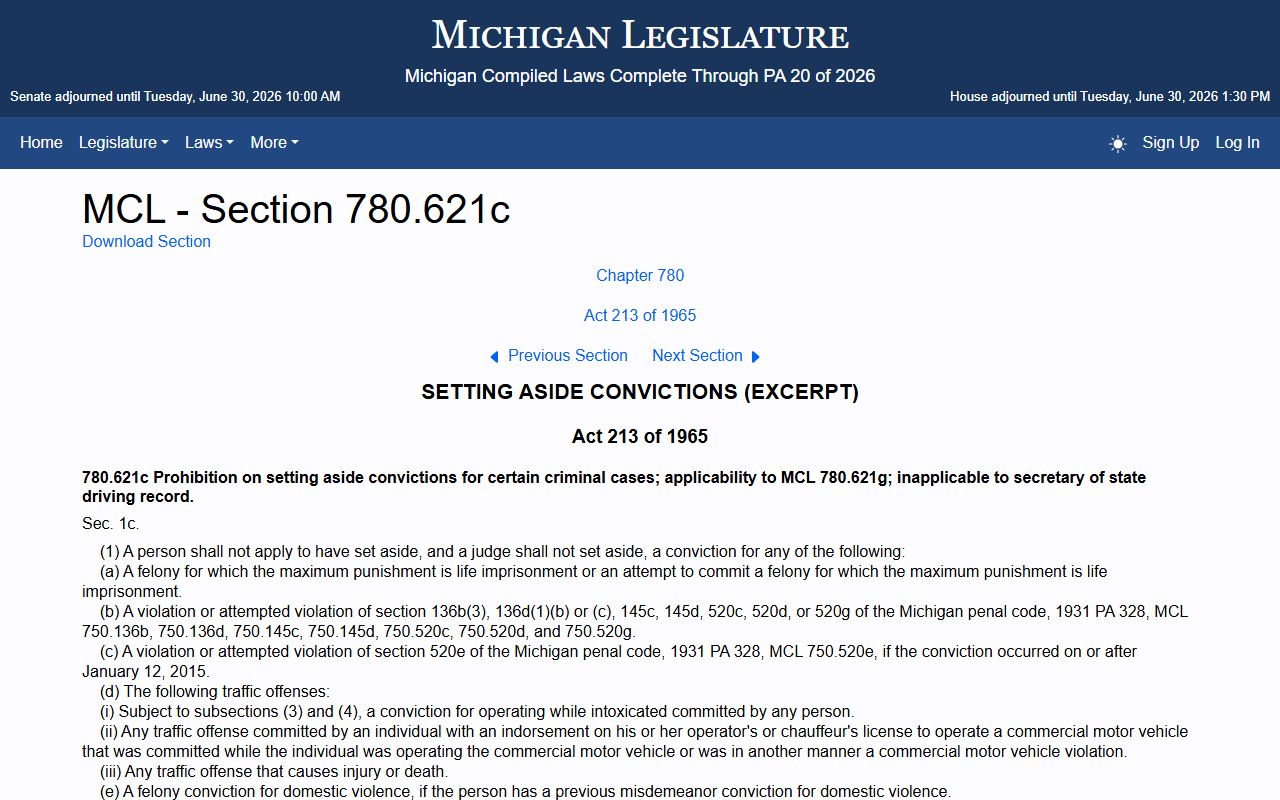
The automatic path is one part of the state's clean-slate reforms, which changed how eligibility and waiting periods work for many convictions.
Set-Aside Eligibility and Clean Slate
Eligibility for a set-aside depends on the offense type, the number of convictions, and the time that has passed since the case closed. Michigan sets different waiting periods for different offense levels, and some minor matters follow their own track. Reading the statute that fits the conviction is the first step before filing anything, because a request for an offense that does not qualify will not succeed.
The minor-offense statute lays out waiting periods and the structure for lower-level convictions. The minor-offense set-aside statute, MCL 780.621d, describes the timing rules that apply to those convictions.
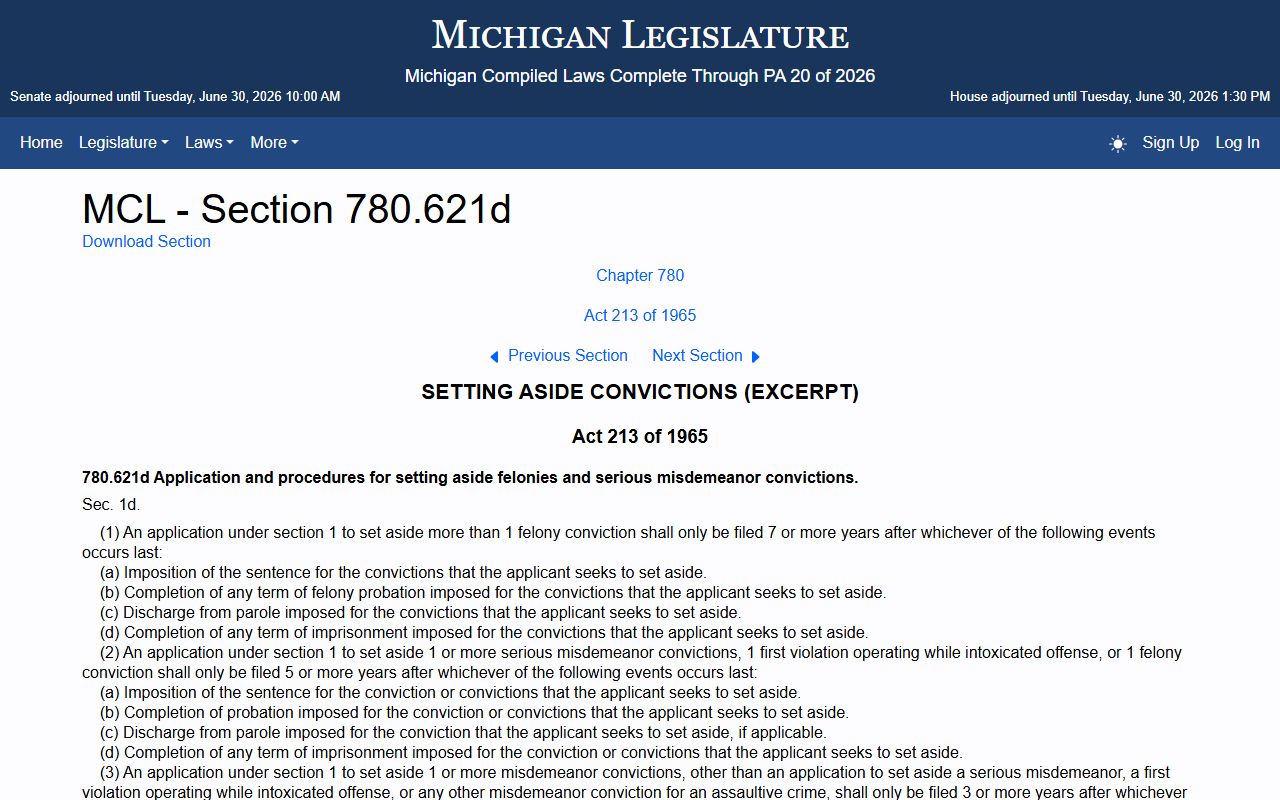
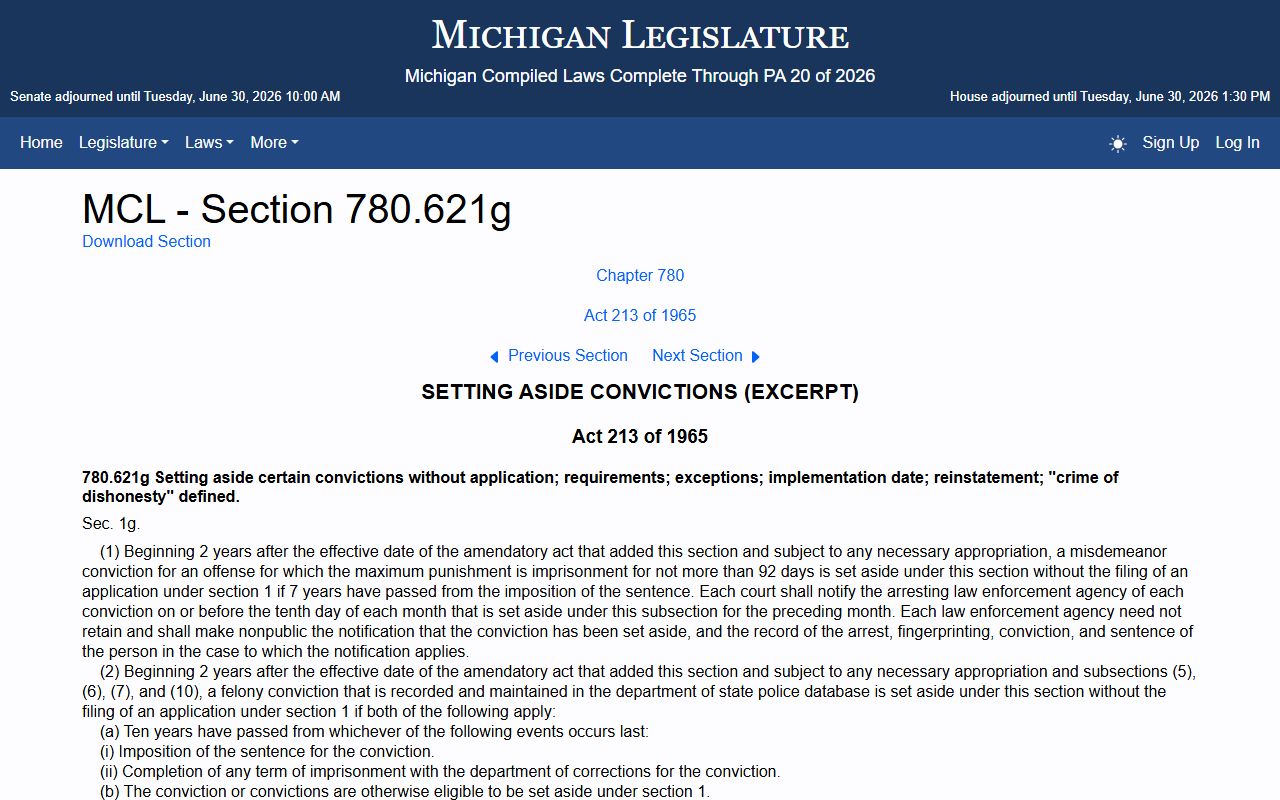
Those waiting periods feed directly into the clean-slate program, which set the state's automatic expungement in motion. The clean-slate statute, MCL 780.621g, spells out the automatic expungement schedule for qualifying convictions.
A person who is not sure whether a conviction has already cleared can check the case in MiCOURT and, if it still shows, file the proper set-aside request in circuit court, notify the prosecutor, and attend a hearing if one is set. If the judge grants the request, the conviction leaves ordinary public view, though the court and law enforcement keep a limited history.
Restricted Criminal Court Records in Eaton County
Some criminal records are limited by law even when the case is real. Juvenile cases are the clearest example, because the state treats youth files far more strictly than adult cases. The juvenile-record access statute, MCL 712A.28, restricts who may see a juvenile record and how it is handled, so these cases do not appear in public search the way adult cases do.
Other files carry their own limits. Sealed cases are hidden from ordinary public access by court order, adoption files are sealed by design, and certain mental-health matters are open only in part. Public copies also redact sensitive identifiers such as Social Security numbers, financial account numbers, and the names of minors where a rule or statute requires it. An open case may also show fewer details while it is still active.
When a record is restricted, the answer is not a workaround but the correct channel. A reader can confirm the status through the clerk of the court that holds the file and, where the law allows, request the parts that remain public. Warrant status tied to a criminal case sits with the sheriff and the court rather than in the case-search summary alone.
Note: A set-aside or a juvenile restriction hides a record from ordinary public search, but it does not destroy the file or erase every law-enforcement record.